
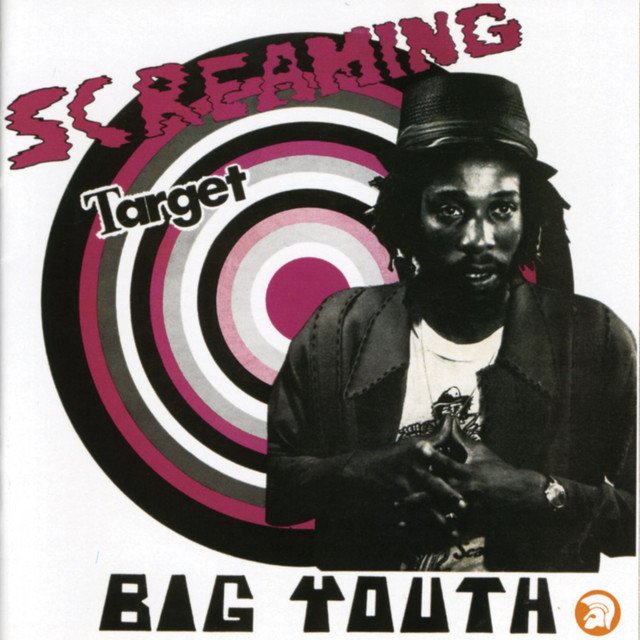
Screaming Target is where Big Youth made the deejay feel like the main event on an album, not a guest voice passing through a rhythm. First issued in Jamaica in 1972, it places Manley Augustus Buchanan’s elastic, unruly and deeply thoughtful voice in the centre of an existing rhythm culture. The record does not treat those rhythms as empty backing tracks. Big Youth answers them, tests them, makes jokes inside them, and turns them toward literacy, faith, dignity and day-to-day survival.
That is why Screaming Target still sounds bigger than an early landmark. It is a compact lesson in what a Jamaican deejay could do when the microphone was given enough room: speak in the language of the sound system, carry a social message without losing humour, and make familiar music feel newly inhabited.
Listen in the archive: hear the complete Roots & Dub Vault upload of Big Youth — Screaming Target.
When the deejay became the album’s centre of gravity
Jamaican deejays had already transformed the sound-system dance before Screaming Target. U-Roy’s recordings had shown that a voice could converse with a record rather than simply introduce it. Big Youth belongs to that first decisive wave, but his character is distinct. His delivery can leap from a hoarse cry to a conversational aside, then settle into a melodic phrase without ever becoming conventional singing. He sounds alert to the room around him: a person talking with listeners, records, neighbours and memory at once. [1] [2]
The record’s title cut gives the method its clearest opening statement. Over K.C. White’s “No No No” rhythm, Big Youth turns a passing reference to a film into a platform for a direct appeal against illiteracy. In a later interview, he recalled using the song to urge young people to go to school. The point is not delivered as a sermon from outside the dance. It comes from inside a voice that is already playful, improvised and recognisably street-level. [3] [4]
That balance matters. The record’s deejay talk is full of ordinary speech, call-outs, comic turns and on-the-spot changes of direction, but it is not empty chat. Across Screaming Target, encouragement, self-respect, faith and warnings about exploitation sit beside vocal gestures that keep the performance loose. The result is a record in which consciousness is not a change of mood imposed on entertainment; it is part of the entertainment’s texture. [2] [4]
From Lord Tippertone to the studio
Manley Augustus Buchanan was born on 19 April 1949 in Kingston; in a 2019 interview, he said he was born in Rae Town. He was one of five children raised by a mother who preached and a father who served as a police officer. It was not, by his own account and others’, an easy household; he left school at fourteen. He found steady work as an auto mechanic at Kingston’s Skyline and Sheraton Hotels, and it was there, apparently, that the nickname was born: coworkers called him “Big Youth” for being both younger and taller than the men around him. Friends who heard him singing in the hotel’s empty rooms on breaks encouraged him toward the microphone instead of the garage. [9] [10]
Before the album, Big Youth was a presence around Lord Tippertone’s sound system in downtown Kingston, becoming its resident deejay by around 1970. Gussie Clarke, the producer credited on the original release, later described the two men as coming from the same community and recalled Big Youth working on Tippertone. Big Youth himself spoke of the sound as the place where he could bring more spiritual and socially engaged language to the microphone than he felt was available in standard crowd-pleasing deejay chat — and, in a 2019 interview, he claimed credit for the sound system’s full name as well, saying: “it’s me that called that sound His Mightiness Emperor Lord Tippertone.” Those are personal recollections, but together they locate the record in a lived sound-system environment rather than in an abstract recording-history timeline. [3] [5]
“Tipper Tone Rock” makes that background audible. Built on Roman Stewart’s “Try Me,” it praises the sound where Big Youth made his name, while the delivery remains relaxed rather than simply boastful. The track shows how close an early deejay record could remain to its dance-floor function: the rhythm had a prior life, the words knew their local setting, and the performance still had to move people. [2] [4]
Big Youth’s earlier “S.90 Skank,” made for Keith Hudson, belongs to the same early-1970s network — a rhythm built from Hudson’s own “We Will Make It Up,” cut with Ossie Hibbert at Dynamic Sounds in 1972, that reportedly sat atop the Jamaican charts for four months. For the parallel story of Hudson’s version-led, studio-minded work, see Big Youth’s earlier Keith Hudson connection. The records are not interchangeable, but they show a young deejay moving through the same Kingston world of producers, sound systems, shops, rhythms and sessions. [5]

Gussie Clarke’s rhythm workshop
Screaming Target is also an early Gussie Clarke statement, made when its producer was barely out of his teens — Clarke was born in 1954, which puts him at around eighteen when the album was recorded, though at least one reviewer has given his age at the time as twenty; the sources don’t fully agree on the exact figure. The original release credits Clarke as producer, with Errol Thompson, Karl Pitterson and Sid Bucknor among the credited engineers; the aggregate release documentation lists Dynamic Sounds, Harry J and Randy’s among the studios. These credits describe the project’s recorded world, but they should not be turned into a track-by-track claim where the evidence does not say exactly who worked on each cut. [1] [6]
Clarke’s background helps explain the record’s speed and practicality. By his own account, he started out as a Kingston sound-system operator in his own right — building his first set, King Gussie’s Hi-Fi, from equipment traded up piece by piece: a transistor amplifier bought with saved lunch money, swapped for a tube amplifier, swapped again for studio time with a rhythm section, which led to a session with U-Roy. He built speaker boxes in woodwork class at Kingston College. From there he moved into importing foreign records for local sound systems and cutting dub plates on equipment bought from Duke Reid, before beginning to export Jamaican records to the UK and US markets himself. [3] [7]
In later interviews, Clarke has recalled Screaming Target as an exceptionally rapid project. Asked directly about the recording, he described it in terms that leave little room between session and shipment: “I think we recorded all the tracks basically in one night, mastered it in one night, printed copies the next day and took them to the UK.” He put the whole project at roughly twenty-four hours, start to finish. That timetable is best understood as Clarke’s own retrospective memory, not as a fully documented minute-by-minute production log. It still captures the urgency of an independent Jamaican record business built on quick ears and immediate circulation. [3]
The first Jamaican editions appeared on Clarke’s Gussie label — catalogue number GLP 001 — and on Jaguar, both in 1972. Trojan issued a UK edition in 1973, helping the album move into the larger British reggae market. Edition history can be confusing because later releases altered track selections and added substantial bonus material. The safest way to hear the record historically is to recognise that the 1972 Jamaican release, the 1973 Trojan edition and later expanded editions are connected but not identical objects. [1] [6]
Clarke went on to a long production career after Screaming Target — building his Music Works studio in Kingston in 1988 and steering some of the biggest digital-era reggae hits to come out of Jamaica, including Gregory Isaacs’ “Rumours” and J.C. Lodge’s “Telephone Love.” Screaming Target sits at the very start of that career, not as an isolated one-off.
The rhythm library: toasting as a conversation
The album works because Big Youth does not need to begin with a wholly new backing track in order to sound original. He enters a library of recordings that listeners could already know and gives each rhythm another social and emotional use. This is not a shortcut around creativity. It is the Jamaican logic of versioning: a rhythm is a resource whose meaning changes when a new singer, deejay, musician, producer or mixer takes hold of it.
For a fuller explanation of how reggae rhythms become dub versions, the Dub Reggae guide follows the same principle from the mixer’s side. Screaming Target makes the vocal side of that process just as clear. Here, the deejay’s timing, speech and subject matter reframe the pre-existing record from the front of the mix.
The rhythm map below is fuller than earlier drafts of this piece, cross-checked against the AllMusic review and a detailed retrospective by music writer Jasper Bark. A few of these routes are corroborated across more than one source; several rest on that one retrospective alone, and are marked accordingly rather than presented with false certainty.
| Big Youth cut | Reported rhythm/source route | Sourcing | What changes in the toast |
|---|---|---|---|
| “Screaming Target” | K.C. White — “No No No,” itself tracing back through Willie Cobbs’s 1960 “You Don’t Love Me” to Bo Diddley’s 1955 “She’s Fine, She’s Mine,” and separately covered by Dawn Penn for Studio One in 1967 | Corroborated (roots-archives, The Afterword) | A rhythm with real depth of its own becomes an opening for wit, a high-pitched cry and a push toward literacy. |
| “Pride & Joy Rock” | Leroy Smart — “Pride and Ambition” | Corroborated (AllMusic, The Afterword) | A lover’s-lament framework becomes a sympathetic, conversational response. |
| “Be Careful” | Dennis Brown — “In Their Own Way” | Single-sourced (The Afterword) | Dennis Brown’s own cautionary song becomes a wider warning to Kingston’s brothers and sisters. |
| “Tipper Tone Rock” | Roman Stewart — “Try Me” | Corroborated (The Afterword, prior draft sourcing) | The rhythm becomes a sound-system autobiography and an invitation to skank. |
| “One of These Fine Days” | Gregory Isaacs — “One One Cocoa” (cited elsewhere as “One One Coco Fill Basket”) | Corroborated, with a title variant (AllMusic, The Afterword) | A patient vocal mood is answered with perseverance and a near sing-jay tenderness. |
| “The Killer” | A fresh cut of “Skylarking” by The Society Squad | Single-sourced (The Afterword) | The rhythm’s energy is pushed toward pure excitement rather than narration. |
| “Solomon A Gunday” | K.C. White’s version of a Gene Chandler & Barbara Acklin B-side, “Anywhere But Nowhere” | Single-sourced (The Afterword) | An obscure soul B-side becomes the base for one of the album’s more theatrical performances. |
| “Honesty” | Lloyd Parks — “Slaving” (also seen as “Slavery” in some writing) | Corroborated (AllMusic, The Afterword) | The album’s social edge comes forward through anti-slavery language, truthfulness and a demand for equal pay. |
| “I Am Alright” | Gregory Isaacs — “Loving Pauper,” stripped by Clarke to bass, drums and rhythm guitar | Single-sourced (The Afterword) | A stripped, bass-led space carries a performance that finds resilience rather than despair. |
| “Lee A Low” | Revisits the same backing track used for “Solomon A Gunday” | Single-sourced (The Afterword) | The album’s finale closes the loop rather than opening a new one. |
The source map above is deliberately selective about its confidence, not just its coverage. It shows a number of the record’s documented rhythm routes; the tracks marked single-sourced rest on one detailed piece of music writing rather than independent confirmation, and should be read that way rather than as settled fact. What matters most across the table is the effect: Big Youth’s voice makes the listener hear the backing tracks as a set of openings, each one carrying a new type of reasoning.
An original Jamaican release, a changing international album
Release documentation is genuinely inconsistent here, and it’s worth naming the disagreement rather than quietly picking a side. Roots Archives’ discography lists the original 1972 Gussie pressing (GLP 001) as a twelve-track LP, with “Screaming Targets (Version 2)” and “Concrete Jungle” already present and marked as bonus cuts on that very first release. Wikipedia’s account instead describes a ten-track original Jamaican album, with those same two tracks added only for the 1973 Trojan UK edition. Both accounts agree on the core ten songs and on the eventual UK route through Trojan; they disagree only on whether the two bonus cuts were already riding along on the first Jamaican pressing or arrived a year later. This piece doesn’t try to resolve that discrepancy — it’s flagged here so nobody mistakes one version of the story for uncontested fact. [1] [6]
Later CD editions expand the picture further: a 2006 Trojan reissue brought the record up to twenty-four tracks, folding in additional rhythms, alternate versions and related recordings from the same sessions and era. This is not merely collector detail. It explains why different listeners can name different “original” running orders when they discuss Screaming Target.
For this Deep Dive, the 1972 Jamaican Gussie/Jaguar release is the historical centre of gravity, because it is the first album form in which this Gussie Clarke–Big Youth collaboration took shape. The 1973 Trojan version matters as the route by which the record reached many listeners outside Jamaica, while the later expanded editions matter as evidence of the unusually dense web of versions around the project.
A dispute that outlived the record’s fiftieth anniversary
There is also a human complication behind the record’s afterlife, and it deserves a more precise account than a general gesture toward “concerns.”
In a 2019 interview, Big Youth described the Screaming Target years bluntly — “that was one of my worst nightmares” — and said he went into the sessions with Clarke on the strength of a working relationship and creative input, with no advance and no formal contract. He has said the album is still called the greatest deejay album by many people, and that it found real success well beyond Jamaica, but he has also said he believes Clarke profited from that success at his expense, telling the interviewer that money owed to him through publishing had, in his words, been taken away. He has spoken of eventually pursuing the matter through the courts.
Clarke has given a different, more specific account. Speaking to DancehallMag in 2024, he said the root of Big Youth’s grievance was a mistaken assumption: because Clarke came to own Jamaica’s largest music-publishing company later in his career, Big Youth apparently concluded Clarke must personally have licensed Screaming Target to Universal Music Group and profited from that deal. Clarke’s account is that it was Trojan Records in the UK — not Clarke himself — that licensed the album to Universal, decades before the dispute became public, and that he says he never received any payment from that arrangement either. He has also directly disputed a more recent claim from Big Youth that the two men co-produced the record, saying Big Youth was the performer and had no role in producing it. By Clarke’s own account, when he tried to explain this directly to Big Youth, the correction wasn’t accepted and no apology followed.
This piece does not try to adjudicate that dispute — the two men’s accounts genuinely conflict on the specific question of who licensed the record and to whom, and on whether the production credit itself was ever shared. What can be said plainly is that the original 1972 and 1973 releases credit Clarke alone as producer, that Big Youth has publicly and repeatedly disputed the fairness of what he received from the record’s success, and that Clarke has just as publicly and specifically rejected the more recent version of that complaint. The creative partnership that produced one of the great early deejay albums did not end on settled terms, and readers coming to the record’s history deserve to know that rather than a softened version of it. [3] [5] [8]
What to listen for on Screaming Target
| Moment | Listen for | Why it matters |
|---|---|---|
| “Screaming Target” | How a yell, a movie reference and an educational message are held inside one easy-moving performance. | It establishes Big Youth’s ability to make social commentary sound conversational rather than instructional. |
| “Tipper Tone Rock” | The warmth of the voice against the rhythm’s unhurried pull. | This is deejay music still close to a particular sound-system life. |
| “The Killer” | How quickly Big Youth can push the performance from smooth narration toward pure excitement. | The album’s theatrical streak never loses its rhythmic control. |
| “Honesty” | The moral weight carried by a seemingly unforced toast. | It is a strong example of roots-era social thought entering the deejay record. |
| Across the LP | The point where Big Youth seems to sing, speak, chant and react all within a few bars. | His style refuses a neat division between deejay, singer, preacher, comedian and storyteller. |
Why Screaming Target still matters
It is tempting to treat this record as a rough draft for what came later: for the more militant roots deejays, for the 1980s dancehall microphone style, or for rap’s global rise. Those connections are real, but they can obscure what is already complete here. Screaming Target has its own tonal world — gentle, mischievous, spiritually serious, sometimes deliberately strange — and Big Youth’s voice is inseparable from it.
The record’s standing among critics has held for decades rather than being a recent rediscovery. AllMusic’s own assessment calls it a benchmark for reggae generally and for the deejay form specifically, and treats it as a classic of recorded music on its own terms, regardless of genre. It was, by some accounts, a favourite dub-era LP among serious critics through the 1970s — Robert Christgau is on record admiring it as one of the decade’s best import-only releases, even though it fell outside the scope of his more general 1970s guide because of that import-only status. None of that critical esteem required decades of hindsight to arrive; it was there close to the start.
The later Dancehall story brings different tempos, technologies and economies to the foreground. Big Youth’s album does not anticipate every part of that later world. Instead, it shows one of the key premises: that a deejay can become a record’s authorial presence even while the rhythm carries its own long history. That is the creative proposition of Screaming Target, and it still feels open each time the voice enters.
Explore further
Follow the Reggae Styles listening map to place Big Youth’s album alongside roots reggae, dub reggae and the later Dancehall continuum.
Related Deep Dives
- Augustus Pablo & King Tubby — King Tubbys Meets Rockers Uptown — a classic 1976 example of the version-minded studio culture that made rhythm reuse so fertile.
- The Morwells — Presenting The Morwells — an independent 1975 roots-album contrast, where a vocal LP also becomes a companion dub question.
Sources and further reading
- Roots Archives — Big Youth: Screaming Target
- AllMusic — Screaming Target review
- United Reggae — Interview: Augustus “Gussie” Clarke
- The Afterword — Fifty Years of Screaming Target
- United Reggae — Interview: Big Youth in Kingston
- Discogs — Big Youth: Screaming Target master release
- John Masouri — Gussie Clarke: From the Foundation
- DancehallMag — Gussie Clarke on the later Screaming Target dispute
- Wikipedia — Big Youth and Wikipedia — Gussie Clarke, used to cross-check biographical dates and the production timeline
- Encyclopedia.com — Big Youth biography, used for early-life and pre-music employment detail